MACD Indicator Trading Guide
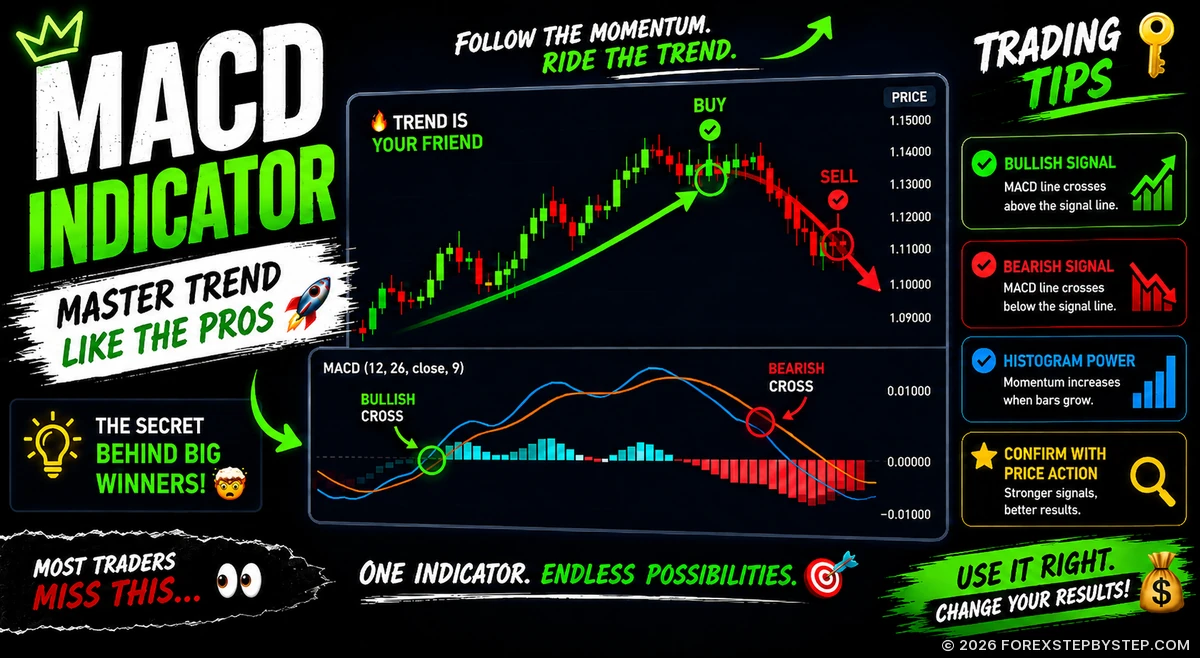
⚡ The Trader’s View of MACD
MACD is not a magic crossover machine. In professional trading, it is a momentum lens that shows whether short-term value is accelerating away from longer-term value, whether a trend is gaining traction, and whether a move is losing energy before price finally admits it.
Used well, MACD can keep a trader on the right side of a strong trend. Used poorly, it becomes a late signal generator that buys the top of a range and sells the bottom of a range.
📌 Executive Summary
MACD, short for Moving Average Convergence Divergence, measures the relationship between two exponential moving averages and converts that relationship into a momentum structure. It is most useful when the market has directional pressure, clean swings, and enough volatility for the shorter average to separate meaningfully from the longer average.
MACD measures momentum by comparing a faster EMA with a slower EMA. The wider the separation, the stronger the short-term push relative to the longer-term baseline.
Traders use MACD to confirm trend direction, spot momentum shifts, identify divergences, and build rule-based entries around pullbacks and breakouts.
MACD performs poorly in tight ranges because moving averages repeatedly compress and cross without meaningful directional follow-through.
- MACD is best classified as a hybrid momentum and trend-following indicator.
- The most reliable signals usually appear when MACD agrees with market structure, higher-timeframe direction, and volatility expansion.
- Signal-line crossovers are not enough. Professionals judge the location, slope, histogram behavior, and price context around the signal.
- The indicator is lagging by construction, so it should support a trading decision rather than replace price analysis.
🧭 What MACD Really Is
MACD was developed by Gerald Appel and became popular because it compresses several useful trading ideas into one compact tool: trend direction, momentum acceleration, momentum deceleration, and potential exhaustion. It does this by measuring the distance between a short-term exponential moving average and a longer-term exponential moving average.
The logic is simple but powerful. When short-term price behavior rises faster than longer-term price behavior, the MACD line moves upward. When short-term behavior falls faster than longer-term behavior, the MACD line moves downward. The signal line then smooths the MACD line, creating a reference point for momentum turns.
Indicator Classification
MACD belongs primarily to the Momentum category and secondarily to the Trend category. It is not a pure oscillator like RSI because it is not naturally bounded between fixed levels. It is not a pure moving average because it converts moving-average distance into a momentum signal. In practice, it behaves like a hybrid indicator.
MACD signals often look beautifully obvious on historical charts. In real time, the difficult part is not seeing the crossover; it is knowing whether the market environment deserves your money.
🧮 Formula, Components, and Calculation Logic
The standard MACD uses three moving-average calculations. The most common setting is 12, 26, 9, although professional traders often adjust these values for instrument behavior and timeframe.
MACD Line
MACD = EMA(12) - EMA(26)
Signal Line
Signal Line = EMA(9) of MACD
Histogram
Histogram = MACD Line - Signal Line
MACD Line
The MACD line shows the distance between the fast and slow EMA. It is the raw momentum engine of the indicator.
Signal Line
The signal line smooths the MACD line and gives traders a reference for momentum turns and crossover timing.
Histogram
The histogram visualizes the gap between MACD and signal line. It often reveals momentum deterioration before a crossover appears.
Calculation Process
First, the platform calculates a 12-period EMA and a 26-period EMA. It subtracts the 26 EMA from the 12 EMA to create the MACD line. Then it calculates a 9-period EMA of that MACD line to create the signal line. Finally, it subtracts the signal line from the MACD line to plot the histogram.
| Setting | Effect | Professional Interpretation |
|---|---|---|
| Faster settings such as 8, 21, 5 | More signals, earlier turns, more noise | Useful for active day trading only when filtered by structure and volatility. |
| Standard 12, 26, 9 | Balanced sensitivity | A practical default for swing trading, indices, FX majors, commodities, and crypto. |
| Slower settings such as 24, 52, 18 | Fewer signals, later confirmation | Better for position trading and reducing whipsaws on higher timeframes. |
Changing MACD settings can improve the look of past trades while damaging live robustness. A professional does not optimize MACD until it perfectly fits one chart; a professional tests whether the logic survives different symbols, sessions, volatility regimes, and spread conditions.
🔍 Reading MACD Signals Like a Trader
MACD signals are not equal. A bullish crossover below zero after a deep pullback inside a strong uptrend is very different from a bullish crossover in the middle of a flat Asian-session range. The indicator may show the same event, but the trade quality is completely different.
Signal Strength Classification
A crossover inside a flat histogram, near the zero line, with no price breakout and no higher-timeframe support. These are the signals that trap beginners.
A crossover aligned with a minor structure break or pullback, but without major session momentum or volatility expansion.
A crossover or histogram expansion that aligns with higher-timeframe trend, clean price structure, a meaningful level, and a clear risk point.
Divergence: Useful, but Often Misused
Regular divergence can warn that the current swing is losing force. Bullish regular divergence appears when price makes a lower low but MACD makes a higher low. Bearish regular divergence appears when price makes a higher high but MACD makes a lower high. Hidden divergence is more useful for continuation: in an uptrend, price makes a higher low while MACD makes a lower low; in a downtrend, price makes a lower high while MACD makes a higher high.
New traders often short every bearish divergence in a strong uptrend. That is dangerous. Divergence does not mean reversal. It means momentum is changing. Price still needs to break structure, reject a level, or fail continuation before the signal becomes actionable.
🌦️ Market Environment: Where MACD Works and Fails
MACD is a momentum tool, so its behavior changes dramatically with the market environment. It shines when price swings have rhythm. It struggles when price compresses into low-quality noise.
- Clean trending markets with higher highs and higher lows, or lower highs and lower lows.
- Breakouts from consolidation when volatility expands and histogram confirms participation.
- Pullbacks into support or resistance where MACD resets without fully reversing trend bias.
- London and New York sessions when liquidity and directional follow-through are stronger.
- Thin ranges where the MACD line and signal line weave around each other.
- Pre-news markets where price waits and then reprices violently after the release.
- Late-trend exhaustion where MACD confirms after much of the move is already complete.
- Low-volatility sessions with no meaningful distance between moving averages.
Session Behavior
- Asian Session: cleaner for range logic, weaker for MACD trend signals on many FX pairs
- London Session: strong for EURUSD, GBPUSD, EURJPY, GBPJPY momentum expansion
- New York Session: strong for US indices, gold, oil, USD pairs, and news-driven continuation
- Overlap Period: often the best MACD breakout environment when structure is already prepared
On EURUSD, many MACD signals during the Asian session become range noise. The same setup during the London open can become a genuine momentum leg because liquidity and order flow are different.
⏱️ Timeframe Analysis and Multi-Timeframe Use
MACD is timeframe-sensitive. A bullish MACD on the five-minute chart may only be a minor pullback inside a bearish four-hour trend. Professionals rarely read MACD in isolation. They locate the larger structure first, then use the lower timeframe MACD for timing.
| Trading Style | Useful Timeframes | MACD Role | Common Adjustment |
|---|---|---|---|
| Scalping | 1-minute to 5-minute | Entry timing after structure forms | Faster settings may help, but false signals increase. |
| Day Trading | 5-minute to 30-minute | Session momentum and continuation | Standard settings usually work with trend filters. |
| Swing Trading | 4-hour to daily | Pullback confirmation and trend continuation | Standard or slightly slower settings are often cleaner. |
| Position Trading | Daily to weekly | Major trend confirmation | Slower settings can reduce noise. |
Use the higher timeframe to define bias, the middle timeframe to identify the setup, and the execution timeframe to time the entry. For example, a trader may use daily MACD for trend bias, four-hour structure for pullback zones, and one-hour MACD histogram turn for entry timing.
🧠 Trading Strategies with MACD
The strategy section is where MACD becomes useful. A crossover by itself is only information. A trading strategy defines the environment, the setup, the trigger, the risk point, the management plan, and the invalidation condition.
ATrend Pullback Continuation Strategy
This is one of the most practical MACD strategies because it avoids chasing the first breakout candle. The logic is that strong trends often move in waves. After the impulse, price pulls back, MACD cools off, the histogram contracts, and then momentum begins to turn back in the trend direction.
Use this strategy when the higher timeframe shows clear trend structure. For long trades, price should be above a rising 50 EMA or 200 EMA, with higher highs and higher lows. For shorts, price should be below a falling major average, with lower lows and lower highs.
Wait for price to pull back toward prior support, resistance, a moving average, or a broken structure level. MACD should reset toward the zero line without creating a full opposite-trend impulse.
Entry Logic
- Confirm higher-timeframe trend direction.
- Wait for a controlled pullback rather than a vertical reversal candle.
- Enter after MACD line crosses back above the signal line for longs, or below it for shorts.
- Prefer entries where the histogram turns from contraction to expansion in the trend direction.
Stop-Loss and Take-Profit
For a long trade, the stop usually belongs below the pullback swing low, not randomly below the entry candle. For a short trade, the stop belongs above the pullback swing high. Profit can be taken at prior highs or lows, measured-move targets, or trailing structure. Many traders scale out partially at the first resistance level and trail the rest behind higher lows or lower highs.
Invalidation
The setup is invalid if price breaks the pullback structure in the opposite direction, MACD crosses but histogram fails to expand, or the higher timeframe loses trend structure. A professional does not keep the trade alive just because MACD crossed once.
BZero-Line Trend Shift Strategy
The zero-line strategy focuses on the moment the fast EMA overtakes the slow EMA. It is slower than a signal-line crossover, but it filters many weak momentum turns. Traders use it when they want confirmation that momentum has shifted beyond a small fluctuation.
The zero line represents the balance between the short-term and longer-term EMA. A move above zero means short-term average price has risen above longer-term average price. That does not guarantee a trend, but it indicates the market has shifted from recovery to possible continuation.
The best zero-line signals happen after price breaks structure, retests the broken level, and then MACD crosses zero in the breakout direction. Avoid signals that cross zero directly into major resistance or support.
Execution Plan
- Mark the last meaningful swing high and swing low.
- Wait for price to break structure in the new direction.
- Watch MACD cross above zero for longs or below zero for shorts.
- Enter on retest continuation, not blindly on the zero-line touch.
- Place the stop beyond the failed retest level.
This strategy suits day traders and swing traders because it captures the early-to-middle stage of a trend change. It is less useful for scalpers because the signal can arrive after the initial move has already traveled too far.
CMACD Divergence Reversal Strategy
Divergence is attractive because it appears before many moving-average signals. The problem is that early does not mean tradable. A strong trend can keep diverging for a long time while price continues moving. Professionals treat MACD divergence as an alert, not an entry.
Look for divergence at meaningful price locations: prior support or resistance, daily highs or lows, round numbers, weekly levels, or exhaustion after a news spike. Divergence in the middle of nowhere is usually low quality.
Wait for price to break a minor trendline, fail a continuation attempt, reject a level, or close beyond a structure point. MACD divergence becomes stronger when the histogram also shifts from expansion to contraction.
Entry and Risk
A bearish divergence entry is usually taken after price forms a higher high but MACD forms a lower high, then price breaks a minor swing low. The stop goes above the divergence high. A bullish divergence entry is usually taken after price forms a lower low but MACD forms a higher low, then price breaks a minor swing high. The stop goes below the divergence low.
Trade Management
The first target should be conservative: previous structure, VWAP area if used, or the midpoint of the prior impulse. Divergence trades are often counter-trend, so taking partial profits early is reasonable. If the reversal develops into a full trend change, the remainder can be trailed using structure or a slower moving average.
DHistogram Breakout Confirmation Strategy
The histogram is one of the most underrated parts of MACD. It shows whether the MACD line is pulling away from the signal line. During real breakouts, the histogram usually expands in the breakout direction. During fake breakouts, price may poke outside a level while histogram fails to confirm.
Use this strategy when price has built a visible range, triangle, flag, or compression zone. It works best around session opens and after periods of volatility contraction.
The market stores energy during compression. When price breaks the range and MACD histogram expands, it suggests that the move is not just a stop hunt but a momentum release.
Execution Plan
- Define the range high and range low before the breakout.
- Wait for a candle close outside the structure, not just a wick.
- Require histogram expansion in the breakout direction.
- Enter on continuation or retest depending on volatility.
- Stop goes back inside the failed breakout zone or beyond the retest swing.
Take-profit can be based on the range height, prior session levels, or trailing if the breakout becomes a trend day. If the histogram quickly contracts after entry and price falls back into the range, the trade should be reduced or closed.
ERange Mean-Reversion Filter Strategy
MACD is not naturally a mean-reversion indicator, but it can help identify when momentum inside a range is weakening. This strategy is not about buying every bullish crossover. It is about using MACD to avoid fading a level while momentum is still expanding against you.
Use only when the market has a clear range with repeated support and resistance reactions. The range should be visible before the trade is considered.
At range resistance, bearish trades are higher quality when bullish histogram expansion stalls and MACD rolls over. At range support, bullish trades are higher quality when bearish histogram expansion stalls and MACD turns upward.
Execution Plan
- Mark the range boundary and wait for price to test it.
- Require rejection, not just proximity to the level.
- Use MACD histogram contraction as evidence that momentum is fading.
- Enter after price confirms rejection with a close back inside the range.
- Stop goes beyond the range extreme; target the midpoint first, opposite boundary second.
FAlgorithmic MACD Framework
MACD can be coded easily in TradingView Pine Script, MetaTrader Expert Advisors, Python backtests, and futures platforms. The danger is that a raw crossover strategy usually performs poorly across mixed regimes. The better algorithmic approach is to make MACD one component in a condition stack.
Use MACD for momentum confirmation, not full decision-making. A robust model may require trend filter, volatility filter, session filter, spread filter, and structure-based exits.
Professional desks may not trade retail MACD directly, but the idea behind it is common: compare short-term momentum against longer-term baseline and trade only when participation confirms direction.
Example Rule Stack
- Trade longs only when price is above the 200 EMA and daily bias is bullish.
- Require MACD above zero or crossing upward after a pullback.
- Require ATR above a minimum threshold to avoid dead markets.
- Avoid entries within a defined time window before major news.
- Exit on opposite structure break, trailing stop, or MACD momentum deterioration.
🎯 Trade Execution: From Signal to Order
MACD gives information; execution turns that information into risk. The distance between those two ideas is where most traders lose discipline.
Require price confirmation: a structure break, retest hold, rejection candle, breakout close, or higher low/lower high. MACD should confirm what price is already suggesting.
Stops should be placed beyond logical market structure, not at arbitrary distances. If the structure breaks, the reason for the trade is gone.
Targets should be based on liquidity, prior highs or lows, support and resistance, measured moves, or risk-to-reward requirements.
🛡️ Trade Management and Risk Control
MACD can help manage a trade, but it should not be the only exit tool. The indicator can remain bullish while price is already pulling back sharply, or it can cross bearish during a normal trend pause. Trade management should combine structure, volatility, and momentum deterioration.
Position Sizing
Risk should be defined before entry. Many disciplined traders risk a small fixed percentage per trade and adjust lot size according to stop distance.
Scaling Out
Partial profits can reduce emotional pressure. This is especially useful when MACD confirms entry but price approaches a major level.
Trailing Stops
Trailing behind swing lows or swing highs often works better than exiting immediately on the first opposite MACD crossover.
Managing Deteriorating Signals
If price moves in your favor but histogram begins shrinking aggressively, it does not automatically mean exit. It means momentum is slowing. A professional then asks: is price still respecting structure, or are buyers or sellers failing? If structure remains intact, the trade can be held. If structure breaks and MACD deteriorates, the exit case becomes much stronger.
The most damaging MACD losses usually come from repeated entries in a range. After two failed MACD signals in the same zone, professional traders often stop trading that pattern until the market changes character.
🔗 Indicator Combinations and Confluence Models
MACD works best when combined with tools that answer questions MACD does not answer. MACD does not know where support is. It does not measure spread. It does not identify liquidity pools by itself. It does not know whether a central bank decision is five minutes away.
| Combination | Purpose | Professional Use |
|---|---|---|
| MACD + 200 EMA | Trend filtering | Take bullish MACD setups above a rising 200 EMA and bearish setups below a falling 200 EMA. |
| MACD + RSI | Momentum confirmation | Use RSI above or below 50 to confirm internal strength, not just overbought or oversold readings. |
| MACD + ATR | Volatility regime | Avoid low-ATR chop and adjust stops according to current volatility. |
| MACD + Volume | Participation | Breakouts with histogram expansion and rising volume are generally more credible than price-only spikes. |
| MACD + Support and Resistance | Location quality | Prefer signals at meaningful levels rather than in the middle of a range. |
| MACD + Market Structure | Trade validation | Use structure to define bias, invalidation, and profit targets. |
The best confluence is not adding five indicators that say the same thing. A strong model combines different information types: trend, momentum, volatility, location, and risk.
📊 Performance Evaluation and Backtesting
No honest MACD guide should promise a fixed win rate. MACD performance depends on market regime, symbol, timeframe, spread, commissions, slippage, position sizing, stop logic, and exit methodology.
Backtesting methodology should include:
Test enough trades to include trending periods, ranging periods, high-volatility periods, low-volatility periods, and news environments.
Include spread, commissions, swaps where relevant, and realistic slippage. MACD scalping systems can collapse after costs.
Vary settings slightly. If the system only works with one exact parameter set, it may be curve-fitted.
Optimize on one period, test on unseen data, then repeat across changing regimes.
Metrics That Matter
Evaluate more than win rate. A MACD strategy with a modest win rate can be profitable if winners are larger than losers. A high win-rate system can still fail if one trend reversal wipes out many small gains.
- Profit Factor: Gross profit divided by gross loss.
- Sharpe Ratio: Return relative to volatility of returns.
- Sortino Ratio: Return relative to downside volatility.
- Maximum Drawdown: Largest peak-to-trough equity decline.
- Recovery Factor: Net profit relative to maximum drawdown.
- Expectancy: Average expected result per trade after wins, losses, and costs.
MACD crossovers repaint visually in the sense that completed candles make historical signals look cleaner than they felt live. Always test using candle-close rules and avoid assuming you entered at perfect prices inside the candle.
🧾 Practical Market Examples
EURUSD trends higher on the four-hour chart. Price pulls back into a prior breakout level while MACD drifts toward the zero line. The histogram stops falling and begins rising. A bullish crossover appears as price forms a higher low. The trade is not based on the crossover alone; it is based on trend, location, structure, and momentum turning together.
GBPJPY sells off during London, then rallies into a broken support level. MACD remains below zero and rolls over as price rejects the level. A short entry is taken after the rejection candle breaks its low. Stop goes above the pullback high, and the first target is the prior session low.
USDCHF trades sideways with small candles and no session momentum. MACD crosses bullish and bearish several times around the zero line. This is a classic no-trade environment for crossover systems. The professional decision is not to find a better MACD setting; it is to recognize that the market is not offering the strategy’s edge.
Gold spikes after a major data release. MACD expands aggressively after the candle has already moved far from the pre-news range. Entering just because histogram expands can mean buying poor location with wide spreads. A better approach is to wait for the first post-news structure, then decide whether continuation or reversal is tradable.
⚠️ Common Problems and Beginner Mistakes
- Use MACD with trend, structure, and volatility context.
- Wait for candle close confirmation when rules require it.
- Separate signal quality from signal existence.
- Track performance by market regime.
- Take every crossover.
- Short strong trends just because divergence appears.
- Optimize settings until the past looks perfect.
- Ignore spread and slippage on lower timeframes.
Most MACD mistakes come from treating the indicator as an instruction rather than a measurement. A crossover says momentum has shifted relative to a smoothed reference. It does not say liquidity is available, risk is acceptable, or the market is likely to trend.
MACD gives traders something objective to point at, which can create false confidence. The real discipline is knowing when the signal is technically valid but strategically poor.
🏦 Professional Insights and Institutional Perspective
Institutional traders may not sit at a desk waiting for a retail MACD crossover, but the concepts behind MACD are deeply institutional: short-term momentum versus longer-term value, acceleration versus deceleration, and participation after a level breaks.
Professionals use indicators as decision-support tools. They build a thesis from market structure, positioning, volatility, liquidity, macro catalysts, and order flow. MACD can support that thesis, but it rarely creates it alone.
Instead of asking whether MACD is bullish or bearish, ask whether MACD is confirming the trade location. A bullish MACD signal at resistance after a five-wave intraday rally is not the same as a bullish MACD signal after a controlled pullback into support.
Professionals care where the signal appears. MACD at a major level carries more meaning than MACD in the middle of noise.
A crossover after a structure break is usually more valuable than a crossover before price has done anything meaningful.
If the signal does not offer a logical stop and reasonable reward, the setup is not tradeable no matter how clean MACD looks.
⚖️ Advantages, Limitations, and Alternatives
| Advantages | Limitations | Alternatives |
|---|---|---|
| Combines trend and momentum in one tool. | Lagging because it is based on moving averages. | RSI for bounded momentum extremes. |
| Works well in directional markets. | Whipsaws in ranges and low volatility. | ADX for trend strength filtering. |
| Useful for divergence and momentum deterioration. | Divergence can appear early and repeatedly. | Stochastic for range timing. |
| Easy to code and backtest. | Raw crossover systems are often fragile. | Moving average systems with volatility filters. |
Avoid MACD as a primary entry tool during narrow consolidation, major news releases, illiquid periods, and markets where price is repeatedly crossing the same moving-average area. In those conditions, the indicator is not broken; the environment is wrong.
🧰 Ready-to-Use Trading Resources
| MACD Reading | Likely Meaning | Trading Response |
|---|---|---|
| MACD above zero and rising | Bullish momentum building | Prefer long continuation setups. |
| MACD below zero and falling | Bearish momentum building | Prefer short continuation setups. |
| Histogram shrinking after strong move | Momentum cooling | Manage trade, watch structure, avoid late chase. |
| Repeated crosses around zero | Range or low-quality chop | Stand aside or switch to range strategy. |
| Divergence at key level | Potential exhaustion | Wait for price confirmation before reversal entry. |
✅ Summary and Quick Start Guide
- Use MACD as a momentum confirmation tool, not a standalone trading system.
- Trade MACD signals in the direction of higher-timeframe structure whenever possible.
- Avoid repeated crossover trades in flat ranges.
- Use the histogram to read momentum acceleration and deterioration.
- Require logical stop placement and realistic target distance before entering.
| Trader Level | Best Starting Approach | Main Focus |
|---|---|---|
| Beginner | Use standard MACD with 200 EMA trend filter. | Avoid counter-trend signals and range chop. |
| Intermediate | Add support, resistance, and multi-timeframe structure. | Improve signal quality and trade location. |
| Advanced | Build rule-based systems with volatility and session filters. | Backtest robustness and manage regime dependency. |
📚 Reference Section
Glossary
❓ MACD FAQ
Is MACD a trend indicator or momentum indicator?
MACD is best treated as a hybrid indicator. Its calculation comes from moving averages, but traders mainly use it to read momentum shifts and trend confirmation.
What are the best MACD settings?
The standard 12, 26, 9 settings are a practical starting point. Faster settings create more signals and more noise. Slower settings reduce noise but confirm later.
Should I buy every bullish MACD crossover?
No. A bullish crossover is only useful when market context supports it. Trend direction, price structure, volatility, and location matter more than the crossover alone.
Does MACD work for scalping?
It can, but lower timeframes create more false signals. Scalpers should use MACD with session filters, spread awareness, structure, and strict execution rules.
Why does MACD fail in ranging markets?
In ranges, moving averages compress and cross repeatedly because price lacks directional follow-through. MACD then produces signals without momentum continuation.
Is MACD divergence reliable?
Divergence is useful as a warning, not an automatic entry. It becomes more reliable near important levels and after price confirms failure or reversal.
Is the histogram more important than the crossover?
The histogram often gives earlier information about momentum expansion or contraction. Many experienced traders watch it closely, especially during pullbacks and breakouts.
Can MACD be used with TradingView and MetaTrader?
Yes. MACD is available on TradingView, MetaTrader, and most trading platforms. It is also easy to code into alerts, indicators, and automated strategies.
What is the biggest MACD mistake?
The biggest mistake is treating MACD as a complete trading system. It should be part of a plan that includes context, execution, risk, and review.
Which markets work well with MACD?
MACD can work on Forex, indices, commodities, crypto, CFDs, and futures when those markets are trending or breaking out with real momentum. It is less effective during dead ranges.
Further Reading and Research Themes
Useful study areas include moving-average theory, trend-following research, momentum persistence, volatility regime analysis, systematic backtesting, position sizing, and behavioral finance. For practical development, traders should study how MACD behaves across EURUSD, GBPUSD, XAUUSD, US500, NAS100, BTCUSD, and USOIL under different sessions and volatility regimes.
🚀 Final Trading Perspective
MACD is valuable when it is used with patience. The indicator’s edge is not in predicting every turn. Its edge is helping traders recognize when momentum agrees with structure, when a pullback is likely to continue, when a breakout has participation, and when a mature move is beginning to lose force.
The professional question is never “Did MACD cross?” The professional question is “Does this MACD signal appear in the right place, in the right market condition, with a tradeable risk structure?”